
Why children remember stories and forget everything you told them
- Mieke from Nuri Tales

- Apr 9
- 4 min read
You've explained it ten times. You've been patient, then firm, then patient again. You've used consequences, you've had the conversation, you've tried every approach you know. And then — the next morning — they do the exact same thing.
It is one of the most exhausting experiences in parenting: the sense that your words are simply not landing. That somewhere between your mouth and their understanding, the lesson disappears.
The reason is neurological. And once you understand it, everything changes.
What happens in the brain during a lecture vs. a story
Uri Hasson, a neuroscientist at Princeton University, has spent years studying what happens inside the brain when people communicate. His finding is striking: when a person listens to factual information or instruction, two regions of the brain activate — the language processing centres. But when they hear a story, the brain response is dramatically different. Multiple regions activate simultaneously: the motor cortex, the sensory cortex, the limbic system, the regions responsible for empathy, and the prefrontal cortex governing moral reasoning.

Even more remarkably, Hasson's research shows that during a story, the brain of the listener begins to mirror the brain of the storyteller — a phenomenon he calls neural coupling. The child who hears about a fox whose heart is beating fast as he decides whether to tell the truth is not merely processing that information. Their own heart rate responds. Their own motor cortex activates. Their own moral reasoning engages the choice. The child does not hear about the decision. They make it.
Why transported minds learn more deeply
In 2000, psychologists Melanie Green and Timothy Brock published a landmark study on what they called transportation theory — the cognitive state of being fully absorbed into a narrative. Their finding was both simple and profound: when a person is transported into a story, they process information less defensively and integrate it more deeply than through any other form of communication.
The reason, Green and Brock argued, is that direct instruction puts people into an evaluative mode — they assess, question, and potentially resist the information being delivered. A story bypasses this entirely. When we are transported, our critical defences lower. We are not being told what to think. We are experiencing something. And experience, unlike instruction, is stored not as information but as memory.
For children, this effect is amplified. Young children do not have the cognitive scaffolding to maintain critical distance from a narrative. When they inhabit the character of a fox who told a lie and felt the weight of it sitting in their chest, they are not observing from a safe distance. They are the fox. The weight is theirs too.
Human brains are not designed to store moral lessons as abstract rules. We store them as episodic memories — wrapped in story structure, tied to characters, anchored in feeling.
The difference between scene and summary
Understanding why stories work neurologically is one thing. Understanding how they work in practice is another — and the distinction comes down to something narrative writers call scene vs. summary.
Summary tells you what happened. Scene puts you inside the moment. When a story summarises — 'the fox decided to tell the truth and felt much better' — the child receives information about a choice. When a story scenes — 'Fox's paw trembled. The words sat heavy on his tongue. He took one breath. Then another. I... I broke the vase, he whispered' — the child lives the choice. Their motor cortex activates as if their own paw is trembling. The neural pathway is created.+
SUMMARY — the child receives information
The fox decided to tell the truth. It was hard, but he did it. And he felt much better afterwards.
SCENE — the child lives the experience
Fox's paw trembled. The words sat heavy on his tongue. He looked at Mama's kind eyes. He took one breath. Then another. 'I... I broke the vase,' he whispered.
In the summary, the child receives information about a choice. In the scene, the child makes the choice — their emotional memory, moral reasoning, and motor cortex all firing as one. The scene creates the neural pathway. The summary does not. This is not a small distinction. It is the entire mechanism.
What this means for the hard moments
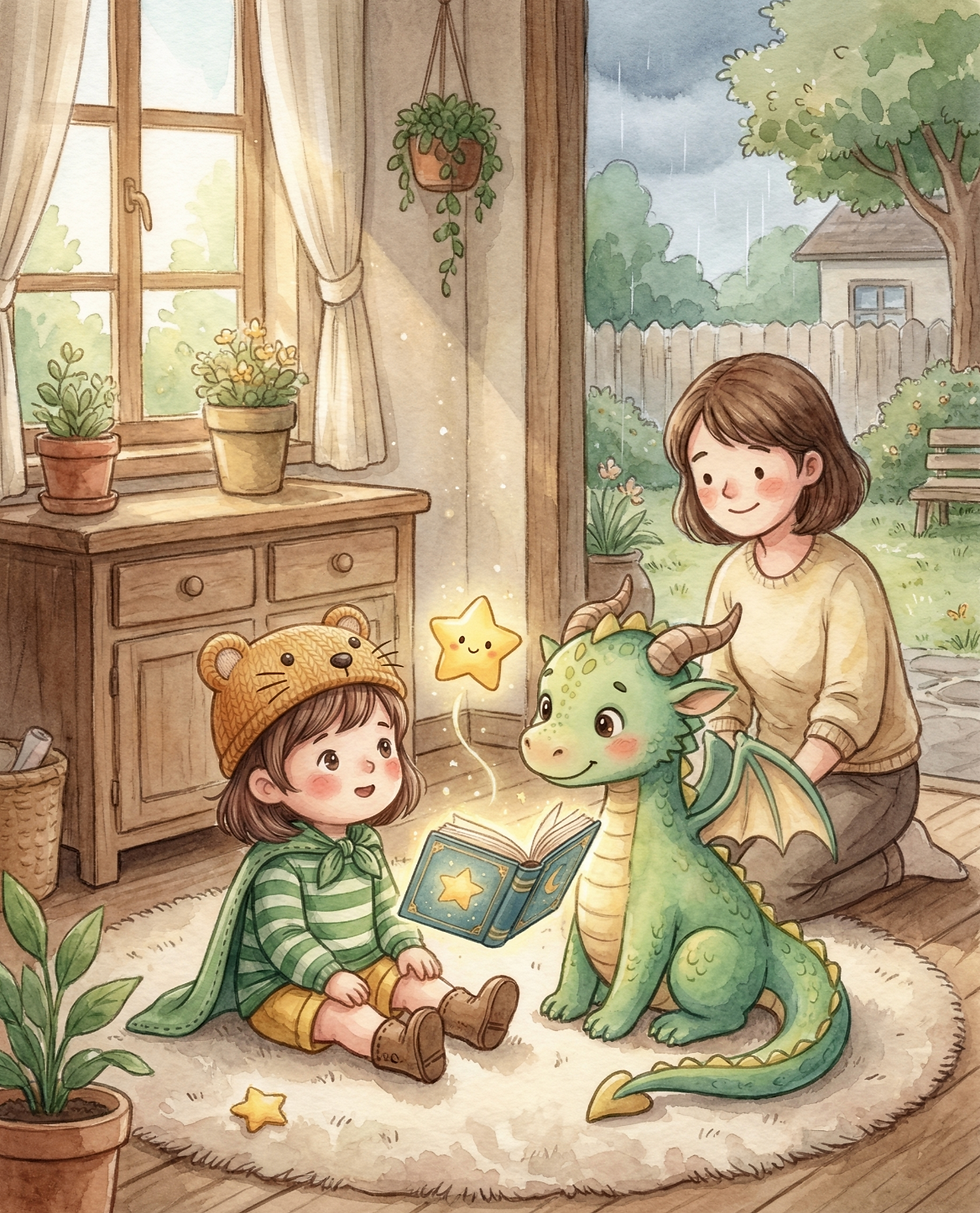
The next time your child does something you want to address — a lie, a tantrum, a refusal to share — try waiting. Not forever. Just until the storm has passed and you are both calm. Then, instead of explaining, give them a character. A fox. A rabbit. A small brave bear. Give the character the same feeling your child had. Let the character face the same choice. Let the story do what no explanation ever could.
The lesson your child will carry is not the one you told them. It is the one they lived — in the borrowed skin of a fox, at bedtime, when the lamplight was warm and you were reading beside them.
 Nuri Tales creates personalised stories at scene level — designed around the specific moment your child is navigating, with the lesson lived rather than stated. Try your first story free. |
Research reference:
Uri Hasson, Princeton Neuroscience Institute — neural coupling during narrative communication. Hasson's work shows that story activates the listener's brain in patterns that mirror the speaker's, a phenomenon not observed during factual instruction.
Melanie Green & Timothy Brock, University at Buffalo — transportation theory (2000). Their foundational study established that narrative transportation reduces counterarguing and increases story-consistent beliefs more effectively than direct persuasion.


Comments