Why repair matters more than perfection — the science of coming back
By Annemieke Lais ·
The parent who never ruptures is not the model of excellent parenting. The parent who repairs — consistently, warmly, without shame — is. Here is the research behind that claim.
There is a parenting myth so pervasive it has shaped an entire industry: the idea that the goal is to get it right. To respond calmly every time. To never lose patience. To say the perfect thing in the impossible moments.
The research disagrees. And not gently.
What the science of attachment actually shows is that the parent who never ruptures is not the model of excellent parenting. Because there is no such parent. The rupture is inevitable. What is not inevitable — and what turns out to be the most important parenting skill of all — is what happens after it.
The rupture-repair cycle — what the data shows
Ed Tronick, a developmental psychologist at the University of Massachusetts whose research into parent-infant interaction has been cited thousands of times, spent years documenting something that will either disturb you or liberate you, depending on where you are today.
In a state of normal, loving, attentive parenting, parents and their young children are mismatched — failing to read or respond to each other correctly — approximately 70 percent of the time. Not in troubled or stressed families. In ordinary, functional, caring ones. The mismatch is not the exception. It is the rule.
What Tronick found was that children with secure attachments were not those whose parents achieved a higher match rate. They were those whose parents consistently repaired the mismatches — who noticed when something had gone wrong between them and the child, and came back. The security came not from sustained attunement but from the child’s repeated experience that ruptures are temporary and relationships are repairable.
“The child who grows up watching ruptures get repaired learns something essential: that relationships survive hard moments. That is not a small lesson. That is the foundation of everything.”
What repair actually teaches
When a parent loses their patience — snaps, says something sharp, reacts in a way they immediately regret — and then comes back and repairs, they are doing something that goes far beyond fixing a specific moment. They are modelling.
Albert Bandura’s social learning theory established that children learn behaviour primarily through observation. They are watching how adults handle mistakes, how they manage the gap between who they intend to be and who they are in a hard moment. A parent who repairs is showing their child: adults make mistakes and take responsibility. Relationships survive difficult feelings. Accountability is not weakness. Love does not evaporate when things go wrong.
These are not incidental lessons. They are the lessons that will shape how that child navigates every relationship they have for the rest of their life.
What effective repair looks like
Repair does not require eloquence. The most effective repairs are brief, warm, and specific. They need to land three things: the rupture is acknowledged, love is unconditional, and the relationship is intact. Everything else is optional.
Repair is not
- A lengthy explanation of your emotional state
- A formal apology ritual
- Extracting forgiveness from the child
- Resolving everything in one conversation
Repair is
- Timely — after both of you have regulated
- Honest — naming what happened simply
- Warm — ending in connection, not correction
- Brief — “I raised my voice. That wasn’t fair to you. I love you.”
The guardrail in every Nuri story
This principle — repair over perfection — is built into the architecture of every story Nuri Tales creates. We never write an adult character who is always wise, always calm, always right. Because that character teaches children something dangerous: that the adults in their lives should be infallible, and that when they are not, something has gone fundamentally wrong.
Instead, our stories sometimes show adult characters making mistakes and acknowledging them. The acknowledgment is not a failure of the adult. It is the most important thing the adult can model.
A story moment that models repair
Mama Bear said, “We need to leave the park now.” Little Bear’s face fell. “But Mama, I didn’t get to go down the slide yet! You said five more minutes, and it’s only been two!” Mama Bear paused. She had been distracted. “You’re right,” she said. “I did say five minutes and I wasn’t keeping track. I’m sorry. Let’s set a timer together this time so we both know when it’s time to go.” Little Bear smiled. “Okay. That’s fair.”
An adult being accountably wrong to a child. That is rare in children’s literature. It is, according to the research, one of the most important things a story can show.
The story as a repair itself
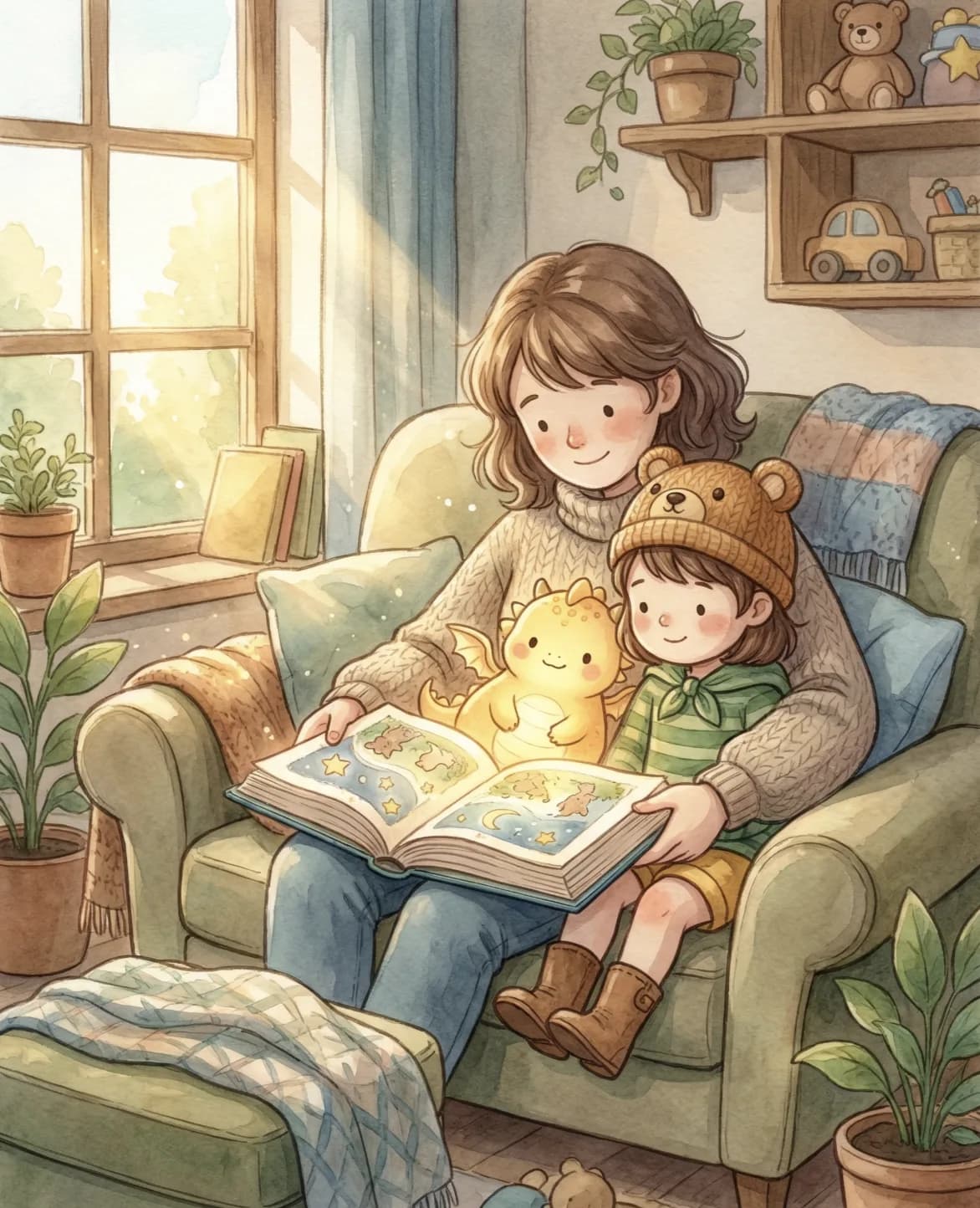
Sometimes the story is itself a repair — not a lesson about the morning’s difficult behaviour, but an act of reconnection after it. A parent who lost their patience, who repaired as best they could, and who then sits beside their child at bedtime and reads a warm, personalised story together is offering something that matters: the signal that the relationship is intact, that the evening is different from the morning, that love is still here.
The story does not have to be about what happened. It just has to be read with warmth. Because warmth, in those moments, is the repair continuing.
Nuri Tales is built for the moment after the storm — a personalised story that meets your child where they are, and helps you find your way back to each other.
See how it worksResearch references
Tronick, E. (1978–2007). The Still Face paradigm and rupture-repair cycle. University of Massachusetts. Tronick’s research demonstrates that interactive mismatches occur in 70% of normal parent-infant interactions, with secure attachment determined by repair frequency and quality rather than match rates.
Bandura, A. (1977). Social Learning Theory. Prentice Hall. Bandura’s work established that children learn behaviour primarily through observation — including how adults manage mistakes, accountability, and repair.
Written by Annemieke Lais, Founder of Nuri Tales