What happens in a child’s brain during a bedtime story?
By Annemieke Lais ·
A bedtime story is not just a pleasant ritual. During those few minutes, multiple brain systems activate simultaneously — and what happens neurologically in that window shapes far more than sleep.
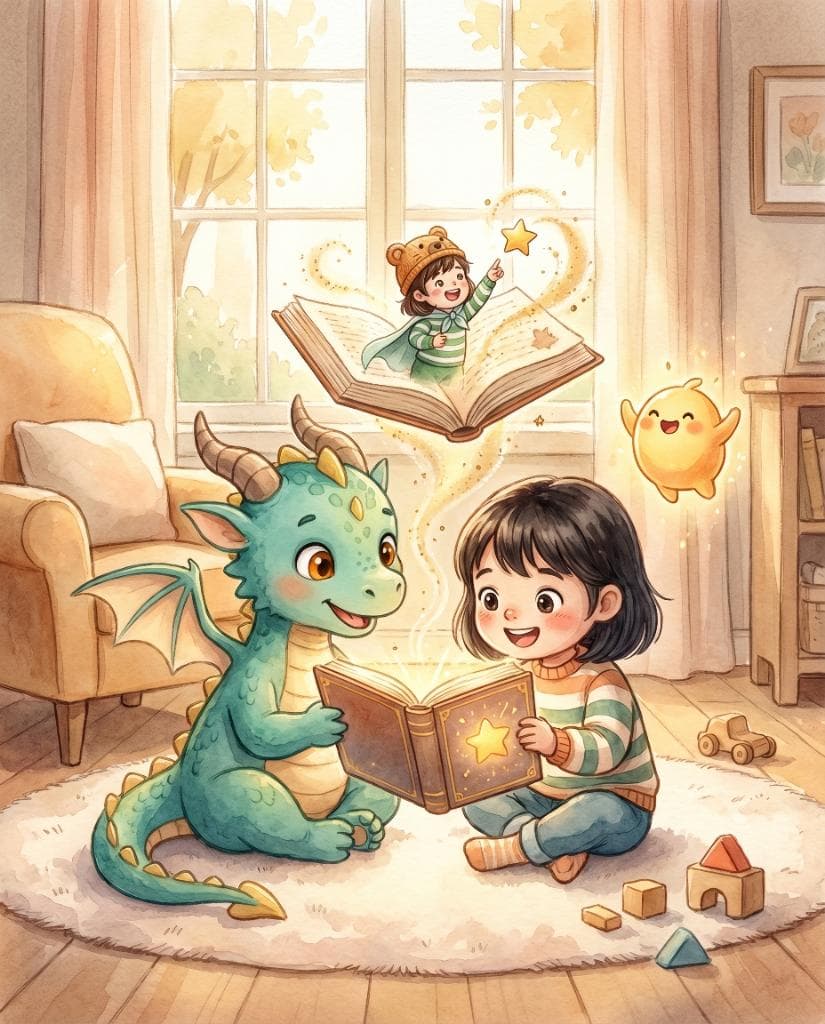
Bedtime stories are often thought of as a comfort ritual — something we do because it feels nice, because it is what our parents did, because it gives the day a gentle ending. All of that is true. But it is also an incomplete account of what is actually happening.
During the few minutes of a bedtime story, a child’s brain is doing something extraordinary. Multiple systems are activating at once — the language networks, yes, but also the emotional processing centres, the social cognition areas, and the memory consolidation pathways that become most active in the window just before sleep.
Understanding what is happening in those minutes changes how you think about the stories you choose — and why the first few seconds matter more than most parents realise.
The first 30 seconds determine everything
The opening of a story sends a signal to the nervous system before the child has consciously processed a single word. Stories that feel judgmental — that are oriented toward a problem, a lesson, or a correction — activate the amygdala. Stress hormones release. The prefrontal cortex, the part of the brain responsible for emotional learning, goes partially offline.
The difference between an opening that closes a child down and one that opens them up is often just a matter of framing:
Closes the nervous system
“Fox told a lie today. This is a story about why lying is wrong.”
Opens the nervous system
“Little fox woke up with a flutter in her belly. Today felt... tricky.”
The second opening invites identification without judgement. The child’s nervous system registers safety. And in that state of safety, real learning — emotional, relational, moral — becomes possible.
The regulatory power of a parent’s voice
Neuroscience has shown that the acoustic properties of speech — its rhythm, pace, and tone — directly affect the listener’s nervous system. Slow, rhythmic speech activates the parasympathetic nervous system: the body’s rest-and-digest state. This is not a metaphor. It is a measurable physiological effect.
The cadence that caregivers naturally adopt when reading to children — unhurried, warm, slightly slower than ordinary speech — is precisely the pattern that signals safety to a young nervous system. This quality is found across cultures in the way adults speak to children at rest. It is not learned. It is instinctive. And it works.
“A parent’s voice is not just delivering a story. It is delivering a nervous system state — one the child can borrow until they are old enough to find their own.”
Co-regulation: borrowing a parent’s calm
Young children cannot regulate their own nervous systems. This is not a character flaw — it is a developmental fact. The circuitry for self-regulation is still forming, and it forms most reliably in the presence of an attuned adult who is already regulated.
A bedtime story, read calmly and warmly, delivers co-regulation within a relational context. The child’s nervous system borrows the parent’s calm. This is why screens and audiobooks — however well-produced — are not equivalent substitutes. They deliver content. They do not deliver the presence of a person who loves you and is here, now, unhurried.
The window before sleep
During sleep, the brain’s default mode network is highly active — processing emotional experience, consolidating memory, integrating the events of the day. A story told in the window immediately before sleep enters this consolidation process.
If a child has had a hard day — a conflict, a moment of shame, a feeling that was too big and went unresolved — and they go to sleep without any processing of that experience, the emotional residue enters that window raw.
A story that holds the emotional territory of what happened — that gives the child a character who felt something similar, who moved through it, who was held by someone who loved them — enters the same window with a different quality. It offers resolution. Not closure in a forced sense, but the felt experience of a hard thing being acknowledged and survived.
That is the compounding impact of a bedtime story done well. It does not just end the day. It helps the brain make sense of it.
Nuri Tales creates personalised stories for the exact emotional territory of your child’s day — timed for the window when they can actually receive them.
See how it worksWritten by Annemieke Lais, Founder of Nuri Tales