Stories vs. screens: what the research actually says
By Annemieke Lais ·
The debate around screens and children is loud and often poorly sourced. Here is what the developmental research actually says — and why the distinction between passive and interactive content matters more than the device itself.
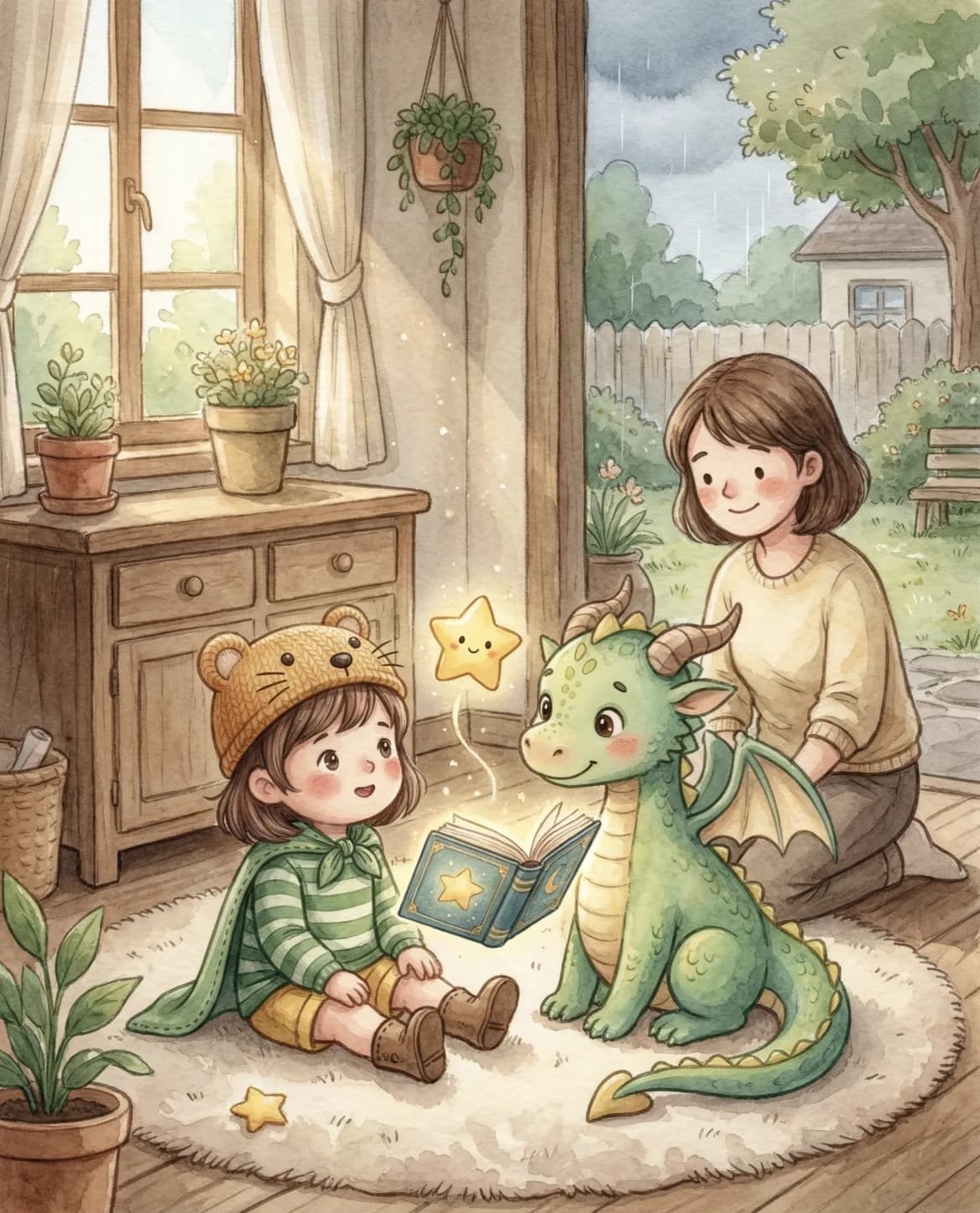
There is a conversation happening in almost every household with young children. It happens at breakfast, at bedtime, on car journeys, and in the quiet of a parent lying awake at night. It sounds something like: “How much screen time is too much?” And it is almost always followed by guilt, regardless of the answer.
We want to offer something different. Not a minute count. Not another rule. Just an honest look at what the research actually says — and a reframe that we think is far more useful for most families.
Because the debate is not really stories vs. screens. It is co-regulated experience vs. passive consumption. And the difference has nothing to do with paper.
The variable that the research actually points to
Dimitri Christakis, a paediatrician at Seattle Children’s Research Institute whose work on early media use has shaped policy at the American Academy of Pediatrics, has spent two decades studying what screen exposure does — and does not do — to developing brains. His consistent finding: “the medium is a weaker predictor of outcomes than the context.”
A parent and child watching something together, talking about it, pausing to discuss what a character feels — that is neurologically and developmentally different from a child alone with a tablet. The content may be identical. The experience is not. What Christakis and colleagues have shown is that the presence of an engaged, responsive adult transforms passive consumption into something closer to co-regulated learning.
This is the variable that most screen time conversations miss entirely. It is not about the minutes. It is about who — if anyone — is present with the child as they experience the content.
What type of conflict does the content use?
There is a second variable that almost never appears in the screen time debate — and it may be the most important one. It concerns the type of conflict the content uses to hold a child’s attention.
External conflict
Threat, danger, suspense, reward loops. Activates the amygdala — the brain’s threat-detection centre. Effective at holding attention, but closes down the prefrontal cortex responsible for reflection and learning.
Internal conflict
Competing feelings, difficult choices, relationship ruptures that can be repaired. Activates the prefrontal cortex — the reasoning and empathy centres. Attention held through identification and meaning.
Engagement-optimised content — the kind designed to maximise viewing time — almost always uses external conflict. It is effective. But amygdala activation closes down the very region of the brain responsible for the emotional learning we most want children to do.
“External conflict activates the amygdala and shuts down learning. Internal conflict — competing feelings, difficult choices — activates the prefrontal cortex and opens it.”
The question worth asking
We are not suggesting screens are harmful, or that families should carry guilt about the choices they make. Most families are doing the best they can with the time and energy available.
But we do think the screen time question is worth reframing. Rather than “how many minutes?” — try asking:
- Is my child experiencing this alone or with me?
- Does this content use internal conflict or external threat to hold attention?
- Does this experience help my child process their feelings — or does it bypass that processing entirely?
Those three questions will tell you far more about the developmental value of a piece of content than any timer ever could.
Why the shared reading moment is irreplaceable
Jerome Bruner, the Harvard cognitive psychologist whose work on narrative shaped modern educational theory, argued that human beings have two fundamental modes of thought: the logical-scientific mode, which processes facts and arguments, and the narrative mode, which processes experience and meaning. Children develop primarily through the narrative mode in their early years — meaning they understand the world through story before they can understand it through argument.
A shared reading moment activates the narrative mode within the co-regulated safety of an attachment relationship. That combination — narrative processing, co-regulation, relational safety — is not replicated by any other medium. The screen can deliver the story. Only the parent can deliver what surrounds it.
Nuri Tales is designed for the co-regulated reading moment — parent and child together, a story built on internal conflict, the lesson lived rather than delivered.
See how it worksWritten by Annemieke Lais, Founder of Nuri Tales